Delivery anywhere in Morocco
100% secure payment
Free expert advice
Installation available
Showroom in Marrakech
2-year warranty on products

Your roof makes your electricity

Panels on your flat roof power the house while you use it, lighten your bill and, with batteries, keep the lights on during power cuts. MAGGMALIGHT surveys, installs and commissions, in Marrakech and anywhere in Morocco.

12345

During the day, the panels power the house and recharge the batteries: you buy almost nothing from the grid.

  1. Solar panels
  2. Hybrid inverter
  3. Batteries
  4. Meter
  5. Power grid
  • Solar energy
  • Batteries
  • Grid

What solar changes for you

With 2,800 to 3,400 hours of sunshine a year, Morocco is one of the countries where a solar panel produces the most.

  • A lighter bill

    Every kWh you produce and use at home is one kWh less to pay for, every month, for the whole life of the system.

  • Air conditioning on sunshine

    In summer, the panels produce the most in the hot hours, when the air conditioning runs: production follows your use.

  • Light during power cuts

    With batteries, the fridge, the lighting, the internet router and the alarm stay powered when the grid goes down.

  • Power without the grid

    A farm, a remote house or a building site gets its own power plant, without waiting for a connection.

  • Decades of production

    Panels last 25 years and more, with a 25–30 year performance warranty from most makers, and need little more than a regular rinse.

  • Clean energy, made on site

    Every kWh from your roof is one kWh less to generate in the country’s thermal power stations.

Estimate your system

Two figures from your electricity bill are enough for a first order of magnitude.

Shown on your electricity bill.

To estimate the saving in dirhams.

When do you use the most?

Suggested power, without batteries

2 kWp

Panels
4 of 500 Wp, about 10 m²
Production
≈ 3,400 kWh a year
Consumption covered
≈ 50%
Saving
Enter your bill amount to see it in dirhams.

To cover much of your evenings as well: about 4 kWp with about 10 kWh of batteries (hybrid system).

Get a detailed survey

An indicative estimate for Marrakech, at about 1,700 kWh per kWp a year, with unshaded panels facing south and the average price per kWh on your bill. Without batteries, the suggested power covers your daytime use: surplus is not bought back yet on low voltage. The survey takes account of your roof, your hours and your tariffs.

Four solutions, depending on what you want

The inverter sits at the heart of every system: at every moment, it chooses where the house’s electricity comes from, panels, batteries or grid. The arrows show the path: orange for the sun, green for the batteries, blue for the grid.

InverterPanelsGridHouse

Grid-tied system

Cut your bill

The panels supply your appliances first; the grid makes up the rest at night and on cloudy days. With no batteries, it is the simplest and least expensive solution.

  • Ideal for: homes, villas, shops and offices that use power by day.
  • Power cut: the inverter shuts down for safety, so it never sends power into a grid under repair.
Hybrid inverterPanelsBatteriesGridHouse

Hybrid system

Ride out power cuts

Grid and batteries together: the day’s surplus is stored for the evening, and the backed-up circuits keep their power during an outage.

  • Ideal for: using your production in the evening and protecting refrigeration, IT, pumps and the alarm.
  • Power cut: automatic switch to the batteries for the circuits you choose.
Inverter-chargerPanelsBatteriesHouse

Off-grid system

Make power with no grid

For a site with no grid: by day, the panels power the site and charge the batteries, which take over in the evening and at night.

  • Ideal for: farms, remote houses, guesthouses, building sites and relay stations far from the grid.
  • Good to know: the batteries are sized for the night and several cloudy days; a generator can serve as backup.
Day: chargingNight: lighting

Standalone solar lighting

Light up with no cable and no bill

Street lights, floodlights and garden bollards with their own panel and battery: no trench, no cable, for paths, car parks and gardens.

  • Ideal for: paths, car parks, roads, property entrances, gardens and sites with no grid.
  • Good to know: nothing on the electricity bill, and quick to install.

Grid-tied, hybrid or off-grid: the differences

CriterionGrid-tiedHybridOff-grid
BatteriesNoYesYes, essential
Evening and nightThe gridThe batteries, then the gridThe batteries (and a backup generator if needed)
During a power cutShuts down for safetyBacked-up circuits keep their powerNot affected: no grid
BudgetThe lowestMedium: the batteries on topThe highest for the same needs
UpkeepPanel cleaning, a yearly checkThe same, and watching the batteriesThe same, and watching the batteries and the backup
Ideal forMostly daytime useEvenings, power cutsSites with no grid

What a system includes

Panels

Monocrystalline, 450 to 600 Wp each today, with a product warranty and a performance warranty (often 25 to 30 years). Facing due south and tilted at about 30° in Marrakech for the best output over the year.

Mounting

On a flat roof, the most common case in Morocco, on a pitched roof, as a car-park canopy or on the ground: ballasted or fixed without harming the waterproofing, and designed for the wind.

Inverter

It turns the direct current of the panels into alternating current, single-phase or three-phase. Grid-tied, hybrid or off-grid depending on the solution, with an app to follow production.

Batteries

Usually lithium iron phosphate (LiFePO4): several thousand cycles, no upkeep. Their capacity, in kWh, is worked out from your evening and backup needs.

Protection

On the DC and AC sides: isolators, fuses or circuit breakers, surge protectors and earthing, in a dedicated enclosure, fitted by our electricians.

Cabling and commissioning

UV-resistant solar cable, neat routing to the consumer unit, tests, settings and a walk-through of the monitoring app.

The protection and the connection to the consumer unit are electrical work: our electrical works service.

Street lights with no cable and no bill

A solar street light carries its own panel and battery: by day the panel charges the battery; at dusk the LED switches on by itself. No cable to run, no trench to dig: the answer for paths, car parks, roads and sites with no grid, for municipalities, hotels, estates and homeowners.

What we check for each location

  • Sun on the panel: facing south, with no tree or building shading it.
  • The battery: enough capacity for long winter nights and for several days without sun.
  • The scenario: full power early in the evening, then dimmed in the middle of the night, or a motion sensor that only turns it up when someone passes.
  • Pole height and spacing: set by the width of the road and the light level wanted, checked with a DIALux study for roads and car parks.
  • Sturdiness: pole, fixing and screws suited to the wind, and protected against theft.
Day: chargingNight: lighting

Law 82-21 on self-production

Since 9 June 2026, the implementing decree of law 82-21, published in the Official Bulletin of 9 March 2026, sets the rules for producing your own electricity, as a household or a business.

Up to 11 kW

A simple prior declaration, for a system connected to the low-voltage grid or not connected at all: this covers most houses and villas.

From 11 kW to 5 MW

A connection agreement from the grid operator (ONEE or your city’s distributor), before the work starts.

Above 5 MW

An authorisation.

The surplus

Energy fed into the grid is capped at 20% of yearly production. On medium voltage and above, ANRE buys it at MAD 0.18/kWh off-peak and MAD 0.21/kWh at peak (excluding tax, from 1 March 2026 to 28 February 2027). On low voltage, the buy-back price has not been set yet.

What it means for you

A cost-effective system is sized to use its own production: every kWh produced and used on site replaces a kWh bought at the price on your bill, far above the buy-back price.

As of 31 October 2026. We check which rules apply to your system during the survey.

One team, from survey to commissioning

1. Survey

Your bills for the last 12 months and when you use power, the roof or the land (area, orientation, shading, access) and the consumer unit.

2. Sizing

Panel power, the inverter and, if needed, battery capacity; expected production and the share used on site.

3. Quote

Equipment, installation and commissioning, item by item.

4. Installation

Mounting, panels, cabling, protection and connection to the consumer unit, by our technicians.

5. Commissioning

Settings, tests, a walk-through of production monitoring and of the upkeep.

For a first estimate, send us

  • Your electricity bills, ideally for the last 12 months
  • Photos of the roof or the land, and of the consumer unit
  • The address or location of the site
  • Your big consumers: air conditioning, pool, cold room, pumps
Send through the Quick quote
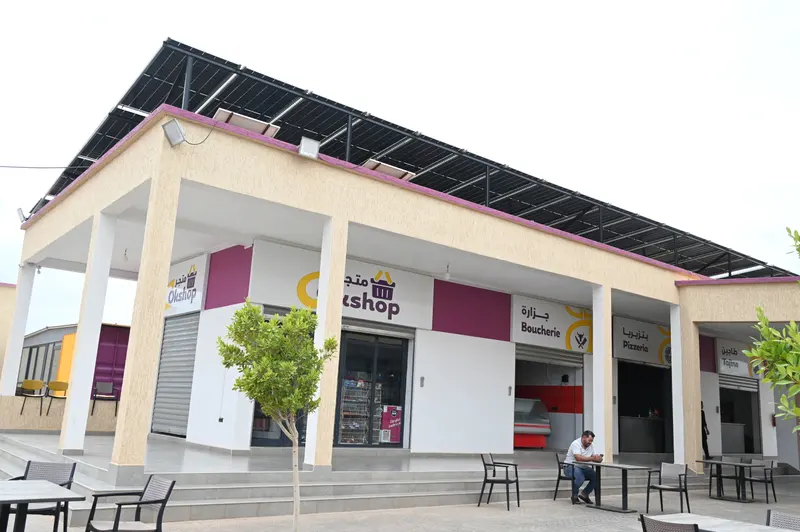
Solar panels on the roof of the OKAY station shop in Tinghir

Grid-tied solar plant, OKAY station in Tinghir

Panels on the flat roofs of the fuel station, an inverter and its protection enclosures: a system built by MAGGMALIGHT.

See the project in photos

Your questions about solar

What do you need for a solar quote?

Your electricity bills for the last few months, photos of the roof or the land and of the consumer unit, and the address: send them through the Quick quote.

Do the panels work during a power cut?

A grid-tied system without batteries shuts down for safety during a power cut. A hybrid system switches to its batteries and keeps the chosen circuits powered.

Can I sell the surplus?

Since 9 June 2026, law 82-21 allows up to 20% of yearly production to be fed into the grid. The buy-back price set by ANRE (MAD 0.18 to 0.21 per kWh, excluding tax) applies to medium voltage and above; on low voltage it has not been set yet. So it pays to use your production on site.

Do I need a permit?

Up to 11 kW, on low voltage or with no grid connection, a simple prior declaration is enough. From 11 kW to 5 MW you need a connection agreement from the grid operator; above that, an authorisation. We check which rules apply to your system during the survey.

Can electricity be stored?

Yes, with a hybrid or off-grid system: the batteries keep the energy produced by day for the evening and the night.

Is my flat roof suitable?

In most cases, yes: the panels are tilted towards the south on a mounting that is ballasted or fixed without harming the waterproofing. What matters most is unshaded space: parapets, stairwells, water tanks and satellite dishes all count.

Does summer heat reduce production?

A little: a panel loses about 0.3 to 0.4% of its power per degree above 25 °C. But the days are so long that summer remains the most productive season: about twice as much a day as in winter in Marrakech.

What upkeep do the panels need?

A rinse with clean water every few weeks in the dry season, early in the morning or late in the day, never on scorching panels, and a check once a year. The inverter’s app shows production day by day: an unusual drop shows up straight away.

Does solar lighting work in winter?

Yes, as long as the panel and the battery are sized for short days and long nights: that is what we calculate for each location.

How long does a system last?

Panels, 25 years and more; the inverter, usually 10 to 15 years; lithium batteries, around ten years or longer.

Do you install it as well?

Yes: survey, supply, installation and commissioning, by one team, with after-sales support 7 days a week.
A solar project?

Send your bills and photos of the roof or the land: we work out the right system and come back to you with a quote.